
Tesla Seasonality: The Best And Worst Times To Trade TSLA
Oct 6, 2025
Not a financial advice. Past results do not guarantee future returns. Do your own research.

Tesla (TSLA) is one of the most followed and actively traded stocks in the world. Beyond the daily noise, seasonality reveals consistent, repeatable patterns in how the stock tends to move during specific months and hours of the day. This is where TradeSeasons gives traders an edge, converting complex historical data into clear, actionable insights.
Tesla’s Monthly Seasonality: A 10-Year View
Looking at the past 10 years of Tesla’s performance (Oct 2015 - Oct 2025), certain months have historically delivered outsized gains, while others consistently show weakness.
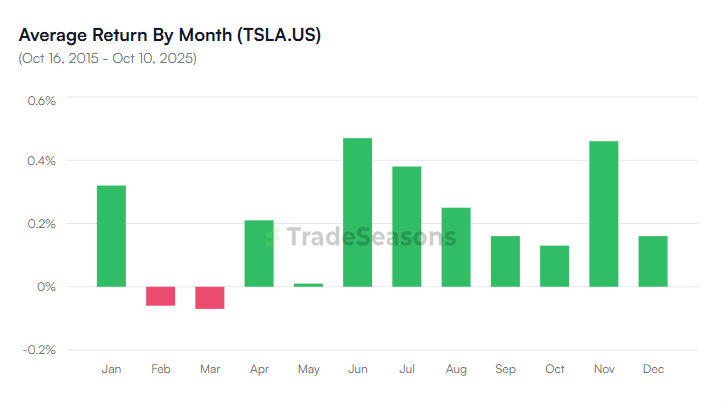
- Strongest Months: June stands out as the best-performing month, followed by November and July.
- Weakest Months: February and March have historically been the most challenging for TSLA.
- Year-End Rally: The stock shows strong, positive momentum leading into the end of the year (Nov & Dec).
These recurring tendencies don’t guarantee future results, but they clearly illustrate the importance of timing when trading a stock as dynamic as Tesla.
Tesla’s Intraday Patterns
Beyond months, Tesla also exhibits sharp intraday seasonality. Analyzing the average return by time (from Oct 2020 - Oct 2025), the data highlights precise windows of opportunity and weakness:
- Best Window (The Open): The period around 9:42 ET shows the largest average positive return of the entire day, highlighting the extreme volatility and directional movement right after the open.
- Mid-Morning Drawdown: Returns become muted after 10:00 ET, often pulling back into the mid-day.
- Mid-Day Weakness: Tesla tends to post negative average returns around 11:30 ET and again at 14:30 ET.
- The Close: Strength often returns in the final hour, with positive returns shown around 15:30 ET.
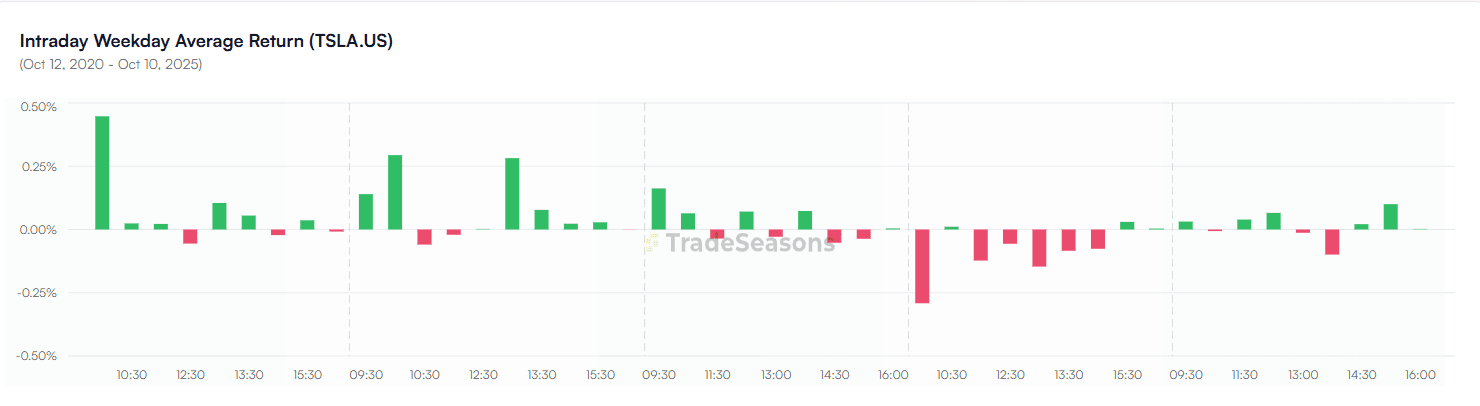
This granular data allows traders to refine not only which months to focus on, but also the specific hours that offer the best opportunities for long or short positioning.
How Investors Use Tesla Seasonality
Tesla’s predictable seasonality can be applied at all levels of trading:
- Swing Traders: Use the monthly strength in June or November to size up long positions, or the weakness in February to size down.
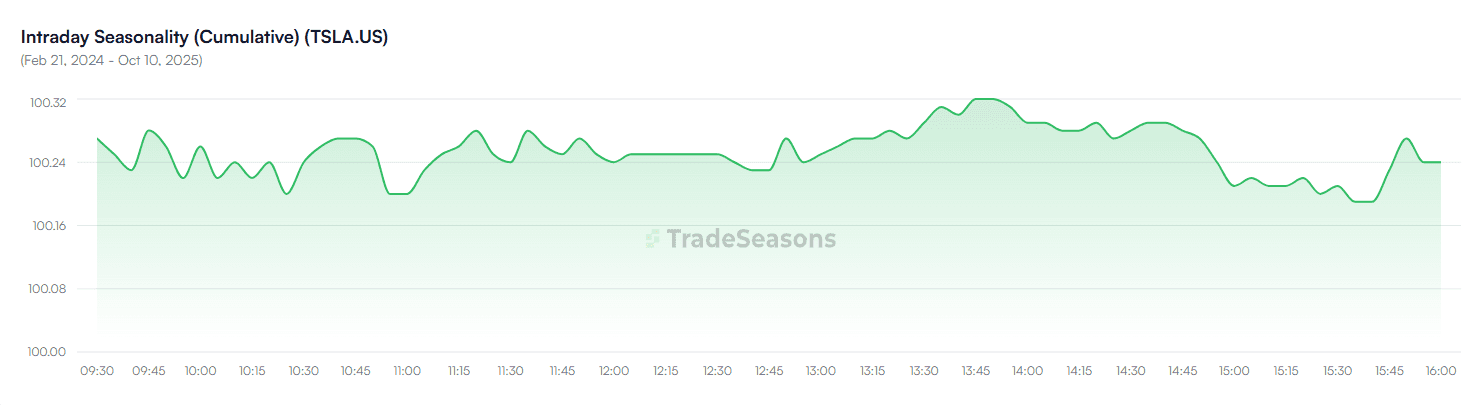
- Day Traders: Rely on the intraday seasonality to fine-tune entries, focusing on the high-volume opening spike (9:30-9:45 ET).
- Long-Term Investors: Use seasonality as context, staying cautious during historically weak periods like early spring and adding to positions during strong months.
Takeaway – Trade Tesla Smarter with TradeSeasons
Tesla will always remain volatile, but that volatility doesn’t mean randomness. Seasonality repeats, and TradeSeasons makes the evidence clear.
Whether you are a day trader watching the first 15 minutes, or a long-term investor planning entry points, TradeSeasons helps you align your decisions with Tesla’s proven historical tendencies.